Microcitrus australasica

Features and care

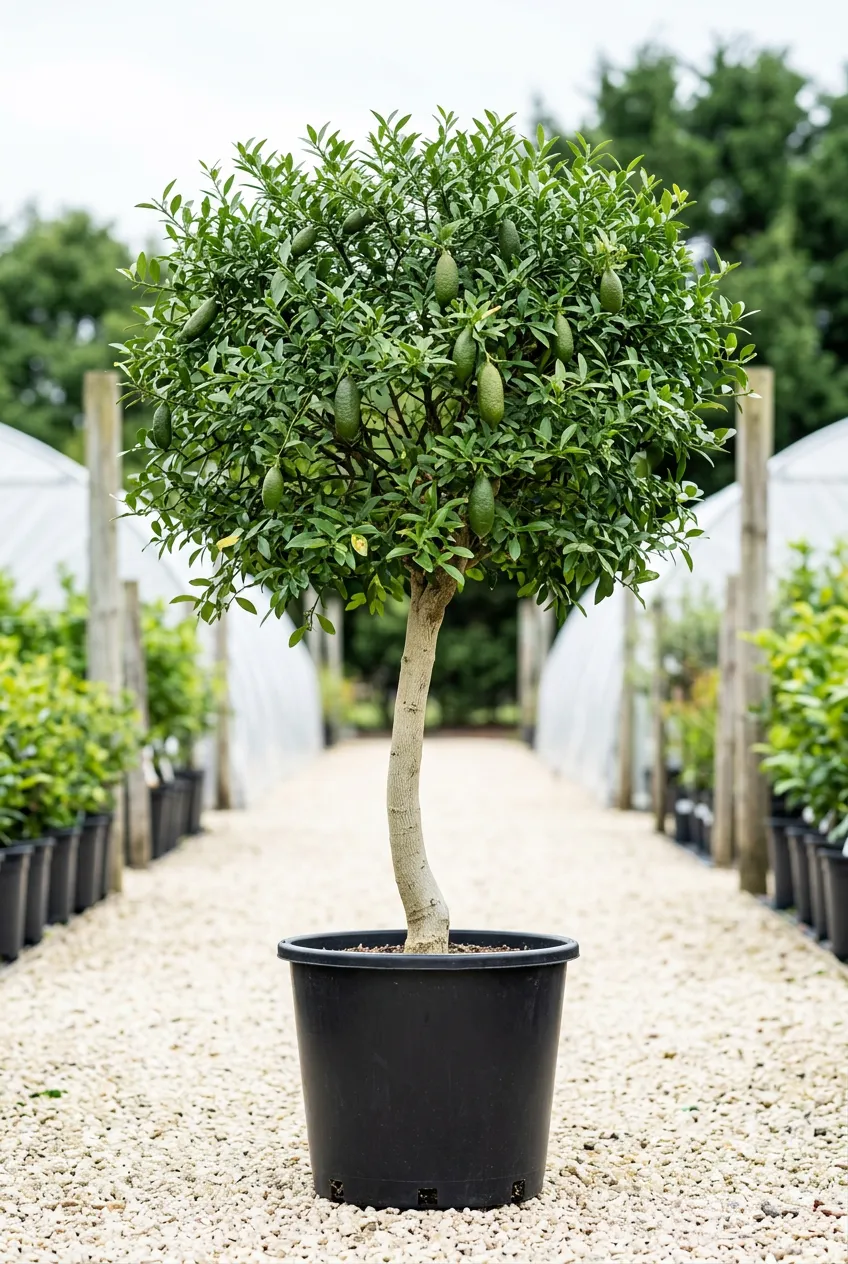
Microcitrus australasica, commonly known as finger lime or caviar lime, is an evergreen shrub or small tree of great ornamental and fruit value, native to Australia. It has an irregular, dense, and highly branched structure, with slender branches that may bear small thorns and narrow, elongated, dark green leaves. Its main attraction is its cylindrical, elongated fruit, with a thin rind of varying colors, whose pulp is composed of small, rounded vesicles resembling caviar.

Of moderate growth, it can reach approximately 2 to 6 meters in height, although it is usually kept more compact through pruning. During spring, it produces small white flowers, generally solitary or in clusters, which later give rise to the characteristic elongated fruits, which can ripen in different shades depending on the variety. The vesicles inside are juicy, aromatic, and acidic, and are used especially in cooking to accompany fish, seafood, salads, desserts, and beverages. It is widely used as an ornamental fruit tree, for container cultivation, in Mediterranean gardens, and in collections of exotic citrus fruits.

It requires direct sunlight or very bright exposure, although it can tolerate light partial shade. It prefers fertile soil, rich in organic matter and with excellent drainage, as its roots are sensitive to excess moisture. Watering should be regular and moderate, especially during the growth and fruiting stages, allowing the soil surface to dry slightly between waterings. It tolerates short periods of drought once established, but is sensitive to intense and prolonged frosts, so in cold climates it should be protected during the winter or grown in a pot. Pruning should be light, mainly to remove damaged branches, control its size, and maintain a balanced structure.
Extended species profile

Verified cultivation data, designed so that any visitor can understand at a glance whether the plant is suitable for their climate and garden.

Crop

Exposure

Full sun

Irrigation

ORN-WATERING 4/5 · high — maintain uniform moisture, increasing in heat; without saturation

Soil / moisture

Fresh to moist; well-drained

Bloom

Summer

Climate

USDA Hardiness

10–11

Compatible climates

Warm Cfa, Cwa, Subtropical Af/Am

Tolerance to humid climate

ORN-HUM 5/5 · very high

Maintenance

Development

ORN-ALT 4/5 · 2–5 m · slow to medium growth

Pests

ORN-PLAGA 5/5 · very high — leafminer, aphids, mealybugs, mites, whitefly and Phytophthora; mandatory phytosanitary control

Pass

ORN-ABONO 5/5 · very high — fractionated citrus nutrition from spring to late summer, with Fe, Mg, Mn and Zn according to analysis

  • Warning

Update the genus; sensitive to frost, dry sun, and wind. Requires phytosanitary monitoring of citrus.

Microcitrus australasica

Contact our sales team

Get a quote