Lagerstroemia indica

Features and care

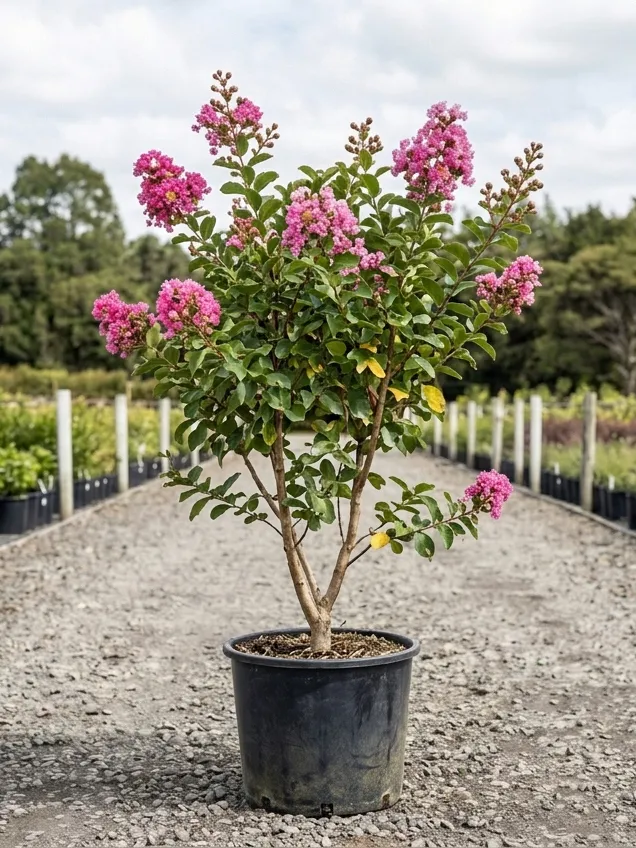
Lagerstroemia indica, commonly known as crape myrtle or Indian lilac, is a large shrub or small deciduous tree highly prized for its abundant summer blooms, decorative bark, and autumnal colors. It can develop with one or more trunks, forming an open, rounded crown between 4 and 8 meters tall. Its green leaves turn yellow, orange, reddish, or purple before falling, while the smooth bark exfoliates with age, revealing grayish, pinkish, and cinnamon hues.

During the summer, it produces large terminal panicles of flowers with wavy, crepe-paper-like petals in shades of white, pink, lilac, red, or purple, depending on the variety. This flowering continues until early autumn and is most abundant in warm, sunny summers. It is an ideal species as a specimen tree, in rows, flower gardens, or large containers, where both its blooms and the interest of its trunk and branches can be appreciated during the winter.

Once established, it tolerates short periods of drought, but excessive humidity, shade, and insufficient ventilation promote powdery mildew. Pruning should be done in late winter or early spring, removing crossing, weak, or poorly oriented branches without resorting to unnecessary severe pruning. At Ornacom, we cultivate each specimen directly, guaranteeing a balanced size and abundant flowering from the first years after planting.
Extended species profile

Verified cultivation data, designed so that any visitor can understand at a glance whether the plant is suitable for their climate and garden.

Crop

Exposure

Full sun

Irrigation

ORN-WATERING 3/5 · medium — regular watering in warm seasons; allow the soil to breathe between applications

Soil / moisture

Fresh; well-drained

Bloom

Summer

Climate

USDA Hardiness

6-9

Compatible climates

Cfa, Cwa, Csa warm, Dfa soft

Tolerance to humid climate

ORN-HUM 4/5 · high

Maintenance

Development

ORN-ALT 4/5 · 4–8 m · average growth

Pests

ORN-PEST 3/5 · medium — aphids, scale insects, mites, and foliar/root diseases depending on environment

Pass

ORN-FERT 2/5 · low — organic matter or slow-release in spring; adjust to vigor and analysis

  • Warning

It needs warmth and sun to bloom; humidity and poor ventilation favor powdery mildew.

Extended species profile

Verified cultivation data, designed so that any visitor can understand at a glance whether the plant is suitable for their climate and garden.

Crop

Exposure

Full sun

Irrigation

ORN-WATERING 4/5 · high — maintain uniform humidity during heat, always with good drainage

Soil / moisture

Fresh to moist; well-drained

Bloom

Summer

Climate

USDA Hardiness

9–11

Compatible climates

Cfa, Cwa, Cfb mild, Aw

Tolerance to humid climate

ORN-HUM 5/5 · very high

Maintenance

Development

ORN-ALT 3/5 · 2–4 m · slow growth

Pests

ORN-PEST 3/5 · medium — mealybugs, spider mites, thrips, and root rot; lower risk of large borers

Pass

ORN-FERTILIZER 4/5 · high — specific fertilizer for palms with K, Mg, Mn, and micronutrients, split during growth

  • Warning

Prefers partial shade; can suffer from burnt tips due to sun, salinity, or dry air.

Lagerstroemia indica

Contact our sales team

Get a quote