Acer pseudoplatanus

Features and care

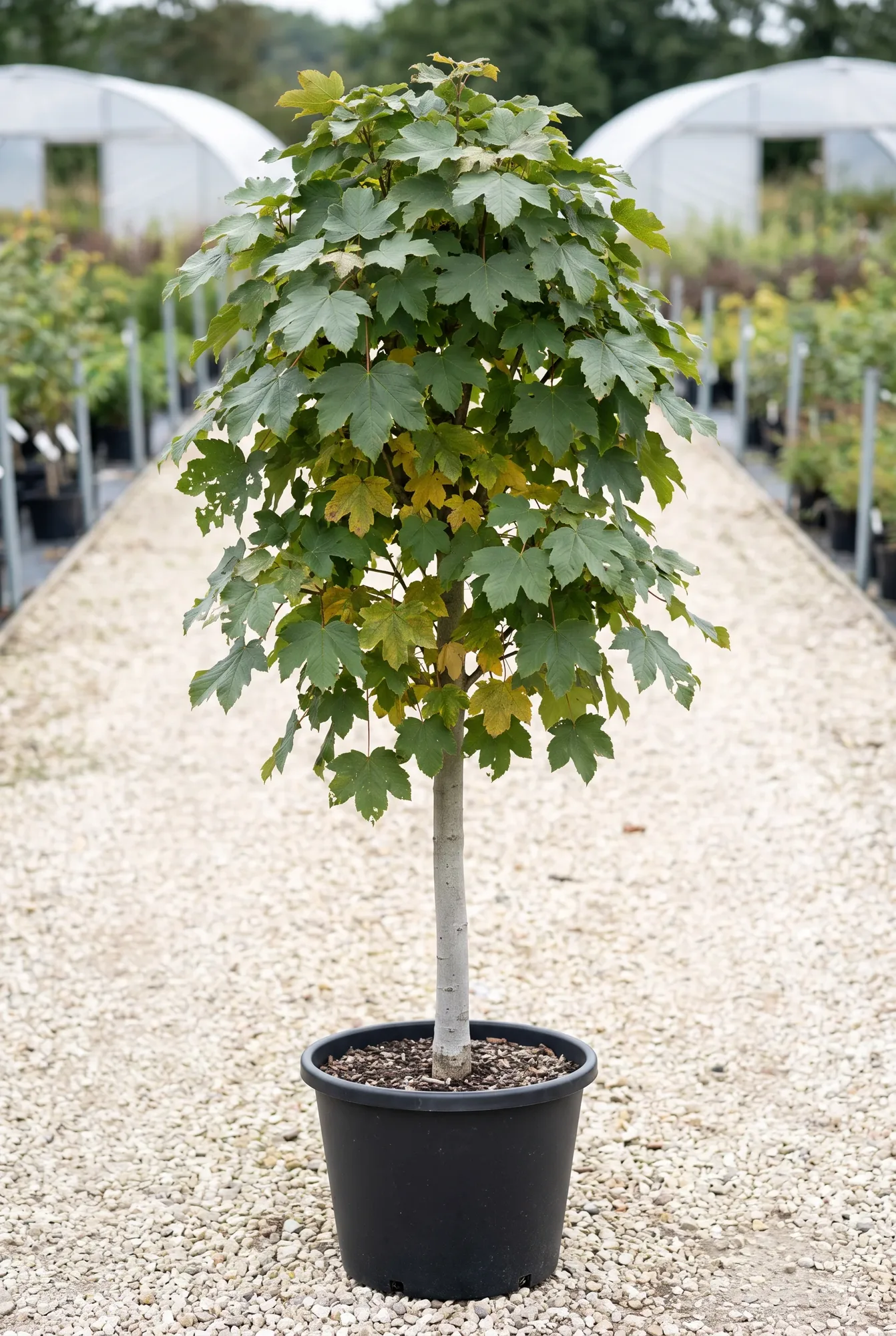
Acer pseudoplatanus, known as the sycamore maple or false sycamore, is a large, deciduous tree with a spreading crown. It has been used as a shade tree and as a landscape specimen in parks and large gardens, where its foliage is the main visual element.

Its leaves are large, opposite, and palmate, with five lobes, serrated edges, and a green surface. In spring, it produces small, greenish-yellow flowers clustered in hanging racemes. Later, samaras form in pairs, while the crown develops a broad, branched structure as the foliage dies back.

It grows rapidly to 20–30 m, in both full sun and partial shade. It prefers cool to moist, well-drained soil, with frequent irrigation to maintain consistent moisture during hot weather. It is adapted to cool climates and humid environments, tolerates frost, and corresponds to USDA zones 4–7; its growth is less favorable under drought or persistent heat.

At Ornacom we cultivate each specimen directly, guaranteeing a balanced size and abundant flowering from the first years of planting.
Extended species profile

Verified cultivation data, designed so that any visitor can understand at a glance whether the plant is suitable for their climate and garden.

Crop

Exposure

Full sun or partial shade

Irrigation

ORN-WATERING 4/5 · high — maintain uniform moisture, increasing in heat; without saturation

Soil / moisture

Fresh to moist; well-drained

Bloom

Discreet

Climate

USDA Hardiness

Zones 4 – 7

Compatible climates

Cfb, Cfc soft, Dfb, Cfa cool

Tolerance to humid climate

ORN-HUM 5/5 · very high

Maintenance

Development

ORN-ALT 5/5 · 20–30 m · fast growth

Pests

ORN-PLAGA 5/5 · very high — colored canker, anthracnose, banana tiger and powdery mildew

Pass

ORN-FEEDING 2/5 · low — prioritize soil and organic matter; fertilize in spring only according to analysis and vigor

  • Warning

It suffers in intense heat and drought; it can be invasive. Its seeds are toxic to horses.

Contact our sales team

Get a quote