Pistacia vera

Features and care

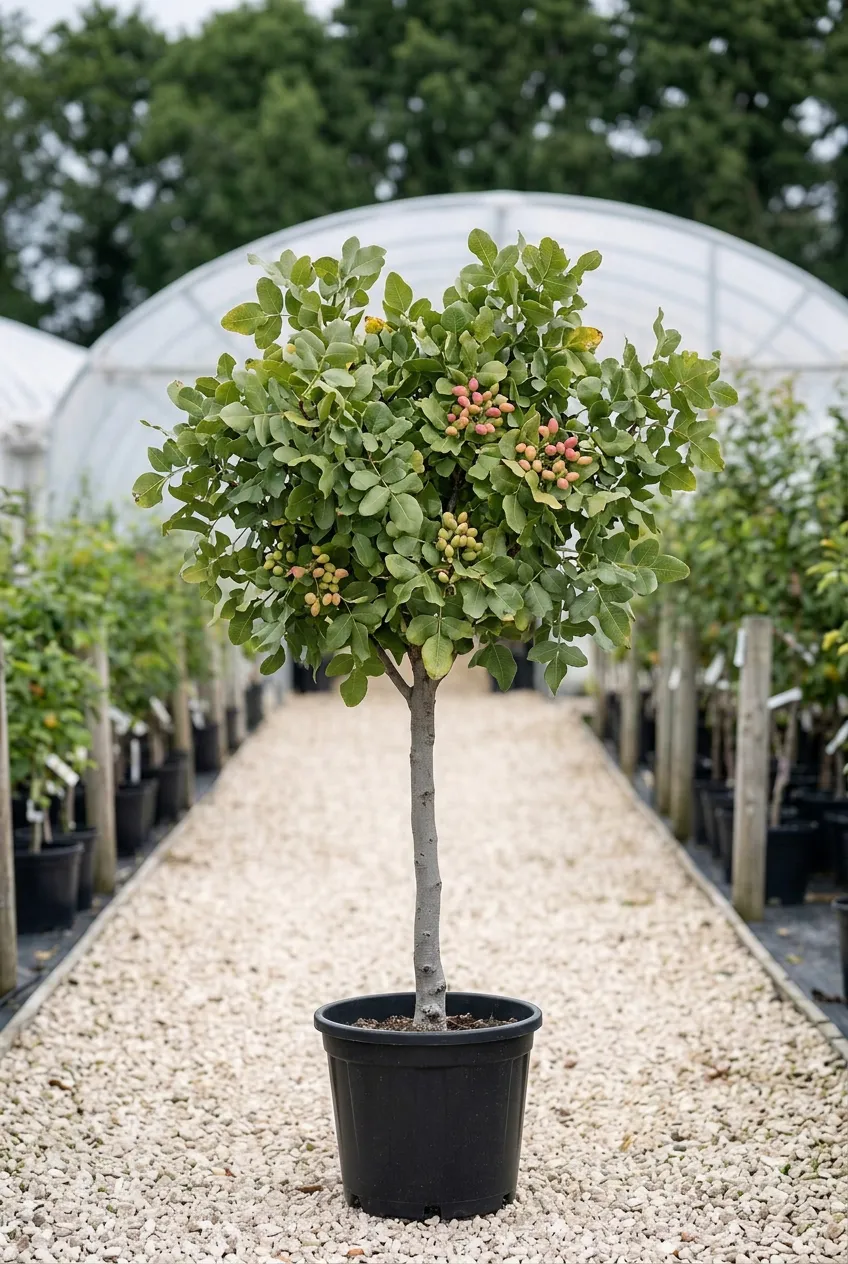
The pistachio tree (Pistacia vera) is a small, deciduous fruit tree with an open habit and slow to medium growth. It can reach between 5 and 10 meters in height, forming a broad, irregular crown that is very resistant to high temperatures. Its leaves are compound, deep green, and turn yellow before falling in autumn. It is a species particularly well-suited to orchards and gardens in dry, warm, and sunny climates, where it can thrive as both a productive and ornamental tree.

During spring, it produces small, petal-less, and inconspicuous flowers clustered in panicles. The pistachio tree is dioecious: there are separate male and female trees, and only the female trees produce fruit; therefore, it is essential to have a compatible male tree that flowers at the same time to ensure wind pollination. The fruits ripen between late summer and autumn, when the outer covering splits open, revealing the pistachio shell. Production begins slowly and can take several years, with larger harvests occurring in mature trees.

At Ornacom we cultivate each specimen directly, guaranteeing a balanced size and abundant flowering from the first years of planting.
Extended species profile

Verified cultivation data, designed so that any visitor can understand at a glance whether the plant is suitable for their climate and garden.

Crop

Exposure

Full sun

Irrigation

ORN-RIEGO 1/5 · very low — very spaced-out waterings; reduce almost completely in winter

Soil / moisture

Dry; excellent drainage

Bloom

Summer

Climate

USDA Hardiness

7–10

Compatible climates

BSk, BSh, Csa, Csb dry

Tolerance to humid climate

ORN-HUM 1/5 · very low

Maintenance

Development

ORN-ALT 4/5 · 5–10 m · slow to medium growth

Pests

ORN-PLAGA 4/5 · high — psyllids, bed bugs, borers and botryospheria/alternaria in humidity

Pass

ORN-ABONO 4/5 · high — fruit program according to soil/leaf analysis; split N and reinforce K without exceeding

  • Warning

It needs warm, dry summers, hours of cold, and male/female feet; humidity favors fungus.

Extended species profile

Verified cultivation data, designed so that any visitor can understand at a glance whether the plant is suitable for their climate and garden.

Crop

Exposure

Full sun

Irrigation

ORN-WATERING 4/5 · high — maintain uniform moisture, increasing in heat; without saturation

Soil / moisture

Fresh to moist; well-drained

Bloom

Summer

Climate

USDA Hardiness

10–11

Compatible climates

Warm Cfa, Cwa, Subtropical Af/Am

Tolerance to humid climate

ORN-HUM 5/5 · very high

Maintenance

Development

ORN-ALT 4/5 · 2–5 m · slow to medium growth

Pests

ORN-PLAGA 5/5 · very high — leafminer, aphids, mealybugs, mites, whitefly and Phytophthora; mandatory phytosanitary control

Pass

ORN-ABONO 5/5 · very high — fractionated citrus nutrition from spring to late summer, with Fe, Mg, Mn and Zn according to analysis

  • Warning

Update the genus; sensitive to frost, dry sun, and wind. Requires phytosanitary monitoring of citrus.

Contact our sales team

Get a quote